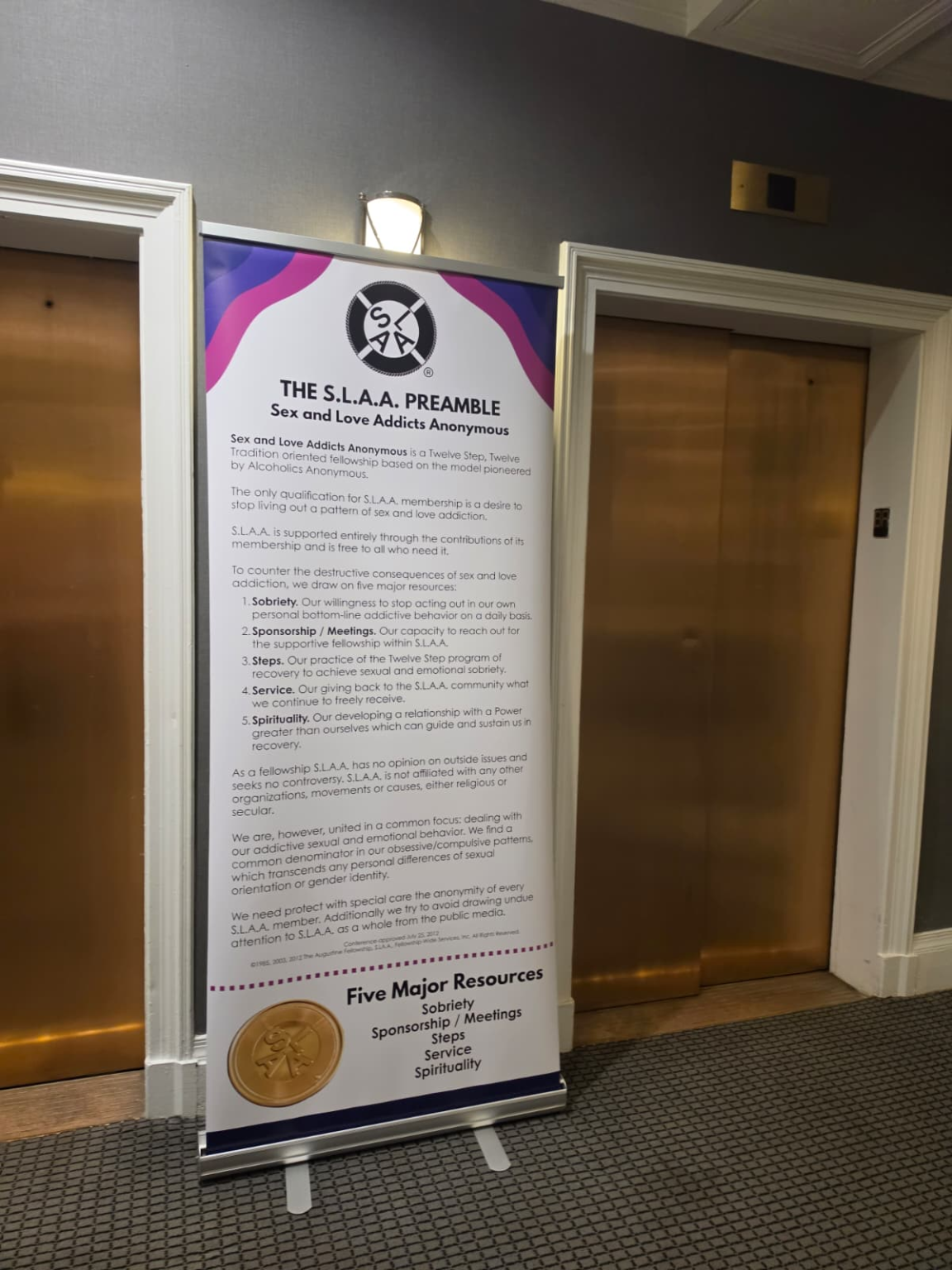
On December 28, 1976, four people, two men and two women, each with a different but recognizable pattern of compulsive sexual and emotional behavior, met in a Cambridge, Massachusetts apartment for about three hours and called what they were doing Sex and Love Addicts Anonymous. Fifty years later, almost to the season, S.L.A.A. members from around the world gathered again: at the Lord Baltimore Hotel in Maryland, USA, in the village of Castletown, County Laois, Ireland, and across five Zoom rooms, tying it all together, for the 2026 International Recovery Convention. The theme, “Five Decades, Five Major Resources,” tied the golden anniversary to the tools that have carried the fellowship from one apartment to nearly sixty countries: Sobriety, Sponsorship and Meetings, Steps, Service, and Spirituality.
What follows isn’t a complete record of four days that included dozens of workshops, multiple plenaries, a silent auction, a bookstore, a ghost tour, and at least one accountability bear. It’s an attempt to capture what it felt like to be there, wherever “there” was.
- Click Here to View the Event Program Book
- Click Here to read A Conversation with Rich

Thursday and Friday: finding the room
The convention opened quietly. Thursday was mostly setup: a Conference Fantasy Committee (CFaC) forum for members who identify fantasy as a central part of their addiction, presenter training, and an evening 12-step meeting running simultaneously in Salon A and in a dedicated Zoom room for people joining only virtually. Fellows gathering at the Pastoral Centre kicked things off with a getting-current meeting, followed by open fellowship, the start of the four-day convention at the Ireland site.
Ireland’s Friday ran on retreat time before Baltimore’s had even started. A Common Opening led by Liam K. doubled as a working group conscience session on keeping the space safe for the weekend, followed by a nature walk along the river through Castletown village, led by Micheál B., and a Share Meeting led by Liam M. Late morning brought Workshop A4, “Working the Steps the S.L.A.A. H.O.W. Way,” where Patrick D. walked the room through a structured framework built around a thirty-day withdrawal period and daily writing assignments, with pairs practicing mock outreach calls along the way. By early Friday afternoon, Ireland had also held its own screening of the five pre-recorded decade speakers who’d later headline Baltimore’s Golden Anniversary Celebration, a preconference workshop introduced by Roland and followed by open sharing.
By Friday morning in Baltimore, the machinery was fully running: registration lines, a bookstore stocked with the newly published A Framework for Living, workshops filling multiple rooms, and more.
Friday’s first full slate set the emotional register for the weekend. In “Focus on Spirituality,” panelists traded stories of faith built and rebuilt through the program. In another room, Megan D.M. led “Fostering Loving & Supportive Community,” walking the room through the Triggers as a Resource framework. The idea: a trigger, examined honestly, tells you more about your own unfinished work than about the person who set it off. Shelby M. used Open Systems Theory to help attendees map which of their relationships were open, and which were quietly closed, using Steps Four and Ten as the diagnostic tool.
Then came the first installment of the convention’s signature series, Five Decades, Five Major Resources, streamed live to Ireland. Meg C. of Massachusetts spoke on Sobriety, the daily, unglamorous willingness to just stop acting out, followed by Rochelle C. on Sponsorship and Luke D. on Meetings (roughly 137 people were logged in via Zoom alone by the time they finished). Ireland’s own team followed with shorter shares on the same three topics. It was only half the series. Steps, Spirituality, and Service were saved for Saturday.
The afternoon got more personal. On a panel about sober dating, Chelsea M., freshly back from a solo trip to Spain she’d been planning since the previous November, described a pattern that had quietly run underneath months of dating in the meantime: meet someone new, instantly cast him as “the person who’s going to come to Spain with me.” The addiction, she said, doesn’t need a real relationship to build an elaborate one. Two others, Fran R. and Luke D. also shared their experience, strength and hope on Sober Dating. Chris D. led a frank discussion on pornography and masturbation as bottom lines. In Ireland, Patrick D. broke Step Four into a series of learnable skills rather than one intimidating task: “the real spiritual work,” he said, “is done by doing a series of practical tasks.” Friday closed with a Lemonade Reception for Baltimore Attendees, Regional Ireland outings for those in Castletown, affinity group 12-step meetings, and dinner.
Saturday: a full day, and an evening to remember

Ireland’s Saturday started earlier still: a gentle yoga session with Chris, thirty minutes of breathwork before anything else began, then a Step 1 panel for newcomers and recently returned members, led by Kevin, and a workshop by Emmet O. on working through Step Eleven with daily inventory and gratitude. Twenty fellows also broke away for a fellowship tour of Emo Court Demesne.
Saturday carried the heaviest workload of the weekend, and its emotional high point. Workshops included Rachel P.’s “When Sponsees Aren’t Ready,” a hands-on workshop with worksheets passed hand to hand across a packed room, built around her own experience sponsoring people who were still, in her words, “digging the hole” while she tried to build the ladder. Meanwhile in Ireland, Emmet O. was back for a second session, walking a mixed in-person and virtual room through the Twelve Traditions as lived experience rather than legal text.
By mid-morning, Mike R. and Lisa M. were sharing about emotional sobriety through a phrase borrowed from grade school: “keep your eyes on your own paper.” “When I try to run the show,” one of them said, echoing the Big Book, “it doesn’t go well.” One salon room over, Jeff R.’s workshop, “Why Not Fantasy?,” traced how compulsive imagination can become as unmanageable as any acted-out behavior, and offered fantasy inventories and mindfulness tools as a way back to the present. From Ireland, Valerie M. led a panel on the female experience in S.L.A.A., born of the observation that Irish meetings, like many mixed online rooms, have historically been heavily male-skewed. It was an honest, generous session, open to every gender.
At noon in the U.S., the Five Decades series returned, live from the Lord Baltimore Hotel and streamed virtually for its second half: Bruce P. on Steps, Chris V. on Spirituality, Jenny R. on Service, running straight into the Saturday Lunch Plenary. Among these heavy topics, convention emcee Dawud K. brought humor and gentle grace, along with his accountability bear, Churchill. Dawud previewed that evening’s festivities with a joke about holding a séance at the notoriously haunted hotel to “conjure recovery speakers who have passed.” It was a good reminder that this convention could hold grief and levity in the same afternoon without much trouble.
The afternoon sessions ran deep. Janice C. and Rick B. spoke on withdrawal, opening with the Serenity Prayer at a speaker’s request, “to help center me.” Loni P. & Terre R. spoke on Steps 8 & 9 workshop on amends. Loni described carrying a three-page list of harms into her fourth step, and asking herself, borrowing a line from a favorite speaker tape, “how free do you want to be?” It’s a question, she said, that took her years of steady step work to really live up to.
Diane D. and a panel of Maryland/DC fellows led an unrecorded, deliberately protected session on Step Three. Eric C. walked attendees through building a one-page, personalized coping-skills toolkit: grounding, urge surfing, trigger mapping, a SMART-goals relapse plan to take home.
Then, at 7 p.m., the convention paused for the evening it had clearly been building toward: the Golden Anniversary Celebration.
Emcee Dawud K.’s opening remarks may at first have seemed unexpected, as he told the story of St. Augustine of Hippo. The connection, however, was quite intentional: S.L.A.A. takes its fellowship name from St. Augustine, whose own story included chasing love and validation through relationships he struggled to stop, praying for self-control “eventually, not now,” and ultimately writing about his restless heart finding rest in something greater than itself. That’s why the fellowship’s formal name is the Augustine Fellowship. The point landed: at fifty years, the language of sex and love addiction is relatively new. The pattern, and the way out of it, is not.
Five recorded speakers followed, one for each decade of the fellowship’s history, each addressing the room from wherever sobriety had found them, the same five recordings Ireland had already viewed on Friday.
- Sarah B., calling in from Rome, represented 2016 to 2025, talked about arriving in the rooms already sober from other addictions, only to discover that love obsession was its own substance entirely, one her brain could manufacture without a drop of anything.
- Manuel M. of California, representing 2006 to 2015, credited a sponsor, a home group, and the discipline to use both.
- Austin H. of Massachusetts, representing 1996 to 2005, talked about growing up the youngest of three, absorbing quiet messages about which parts of himself were and weren’t acceptable, long before he had language for any of it.
- Deb W. of Ohio, representing 1986 to 1995, had recently turned 70 and, this past June, marked 35 years of continuous S.L.A.A. sobriety. She told the room simply, “I am fully engaged in my life. I’m no longer stuck in my addictive world.”
- The evening closed with a recorded message from S.L.A.A.’s first member and the lead author of the S.L.A.A. Basic Text, representing the founding decade of 1976 to 1985. He shared the morning prayer he still says every day, thanked the fellowship for fifty years of carrying the message, and signed off with a promise: “Tomorrow, I’ll have the opportunity to join you live.”
Ireland’s Saturday ended on a different note entirely: a Gala Dinner, followed by a Celebration Night ceilidh (dance) with S.L.A.A. Ireland’s own musicians, running late into the night.
Following the decade recordings, U.S. members had the opportunity to enjoy some “healthy” dancing, with structured favorites like the Macarena, Hokey Pokey, and Chicken Dance. There was plenty of laughter and fun in a sober environment. After about ten songs, Elle D. took over as the karaoke DJ, with members taking turns singing while others enthusiastically cheered and sang along.

Sunday: Ireland wakes up, and the circle closes
While Baltimore slept, Ireland’s program ran through the pre-dawn hours of the U.S. schedule. In a candid roundtable, Paul F. facilitated a discussion among fellows who had been through residential and outpatient treatment in Ireland. Several traced their addiction back to adolescence. One panelist, who’d worked in addiction treatment since the early 1990s, asked the room directly: has anything really changed? Micheál B. spoke about growing up gay in rural Ireland and how that shaped an early life in addiction. Martin M. led a storytelling and poetry workshop centered on the Twelve Steps, which closed with an exercise inviting attendees to invent “twelve secret names” for someone they love. In a session called “A Therapist’s View,” John D., a psychologist in private practice near Castletown and a member of the fellowship for nearly a decade, offered guidance on choosing a therapist who understands twelve-step spirituality well enough not to inadvertently deepen a client’s shame.
Ireland’s own convention closed at midday with “Outside the Bubble,” a re-entry workshop meant to help attendees carry the retreat back into ordinary life, followed by a Farewell Luncheon before fellows scattered back across the country.
Baltimore and the virtual room woke to a final stretch of workshops: Michelle N.’s “Envelope Inventory,” a compact Step 1-11 exercise built entirely around an envelope and an index card; Rick B. had a lot of wonderful participation in his session called “Winning at the Game of Anorexia Recovery;” and Lisa S. guiding the room through meditation for self-love. Then came the Getting Current Meeting: attendees from Kentucky, Pennsylvania, Massachusetts, Virginia, North Carolina, and a dozen points between, going around the circle by first name and home state (at least one birthday got called out along the way), before opening the floor for closing shares.
At noon, the promise from Saturday night was kept. Rich joined the closing plenary live for “A Conversation with Rich.” Event co-chair John D. PA posed a series of questions that Baltimore and Castletown attendees had submitted in writing over the weekend.
At 1:30, event co-chair Ari F. facilitated a very emotional reverse sobriety countdown, from individuals with less than 24 hours of sobriety to the fellowship’s original member, with fifty years.
Keep Coming Back
None of this happens without a small, mostly volunteer team running two convention sites and a virtual one at the same time. Logistics, tech, registration, program, and outreach were split across a U.S. team and an Ireland team working across a five-hour time difference for the better part of a year.
Fifty years ago, four people in an apartment weren’t sure the thing they had started would last past the following Tuesday. This year, several hundred attendees in Ireland, Canada, Brazil, France, Spain, Belgium, Italy, Switzerland, Australia, Germany, South Africa, the United States, and beyond proved that it has. Discussions are now underway for future gatherings, such as the upcoming GDVI Halloween Steps Retreat, “Trick or ReTreat“. But for one weekend in August, we mostly just paused to look back and say, together: thank you, and keep coming back.
– John D. PA & Ari F. NJ/CA